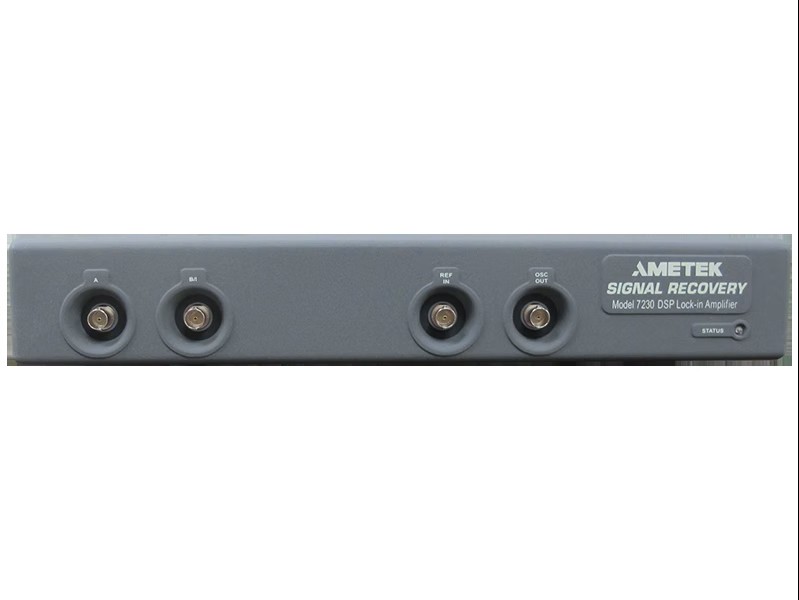
7230A General Purpose DSP Lock-in Amplifier
Signal Recovery originated from the Princeton Applied Research, EG&G products for scientific instrumentation. They are the inventors of the lock-in amplifier. A lock-in amplifier is an instrument with dual capability. It can recover signals in the presence of an overwhelming noise background or, alternatively, it can provide high resolution measurements of relatively clean signals over several orders of magnitude and frequency.
Description
Overview
The model 7230A is a new concept in general-purpose DSP lock-in amplifiers. It offers the excellent signal recovery performance that users expect from our instruments but at a lower price than many competitive models. We’ve achieved this improvement in price/performance ratio by replacing traditional control buttons and display with easy-to-use control panels that can be operated from any computer via your favorite browser. No longer do you need to be in front of the instrument to operate it—now you can set up your experiment in the lab but return to the office while it runs, monitoring what is happening via your computer. And if you need to make a change to a setting, then it’s as easy as clicking a button on a web page.
You can use any web compatible device to operate the model 7230A, ranging from a simple netbook to the most powerful development machine, from an Android smartphone to the latest iPad. No special software is needed, since the panels work directly through the device’s browser. All that is necessary is that the computer and instrument be connected to the same Ethernet network.
The instrument is also much more compact than traditional designs, making it easier to accommodate in crowded laboratories. And, it does not include any cooling fans so it is completely silent, which is especially useful for acoustic research.
Model 7230A offers an operating frequency range of 1 mHz to 250 kHz.
Versatility
In common with other models in our range, the 7230A offers much more than just dual phase lock-in detection at the reference frequency of an applied signal. It includes features unique to SIGNAL RECOVERY instruments such as dual reference and dual harmonic detection, which allow signals at two different frequencies to be measured simultaneously, and tandem demodulation. It also includes virtual reference mode, allowing reference-free measurement of suitable signals.
Highlights
- Remote control via software only (no built-in display)
- Dual reference and dual harmonic detection allow signals at two different frequencies to be measured simultaneously
- Frequency range 250 kHz to 1 mHz
- Ethernet, USB, RS232 connectivity
- Compact design has no mechanical fans and is completely silent, especially useful for acoustic research
- Software included – Acquire PC software, browser control software, LabView and SRInstComms
Applications and Software
Signal Recovery originated from the Princeton Applied Research, EG&G products for scientific instrumentation. They are the inventors of the lock-in amplifier. A lock-in amplifier is an instrument with dual capability. It can recover signals in the presence of an overwhelming noise background or, alternatively, it can provide high resolution measurements of relatively clean signals over several orders of magnitude and frequency.
- Dual Reference—Simultaneously measure two signals at different frequencies
- Spectral Display—See the power spectral density of the input signal plus noise
- Dual Harmonic—Simultaneously measure two harmonics of the reference frequency
- Virtual Reference—Make reference-free measurements even on noisy signals
- VCO—Use external analog signal to control the frequency or amplitude of the precision internal oscillator
- Synchronous Oscillator Output—Access the sinewave being used for demodulation, including any frequency multiplication and/or phase shift
Specifications
Specifications
- Display: Remote control only (no display)
- Frequency range: 250 kHz to 1 mHz
-
Sample rate: Main ADC and analog outputs update rate of 1 MSa/s
-
Reference modes: Dual Reference, Dual Harmonic and Virtual Reference
-
Dynamic reserve: 100 dB for 1 nV / √Hz
-
Connectivity: Ethernet, USB, RS232
-
PC Software (included): Acquire, LabView, SRInstComms
Documentation
Download / View Documentation
 Loading...

 Reload document
  Open in new tab
 You Tube