
Unlocking Precision: A Complete Guide to Industrial Lasers in Dutch Manufacturing
If you make things in the Netherlands, you already live with industrial lasers — even if you never see them. They cut the brackets in your machine frame, weld the battery tabs in your e-bike, mark the UDI code on a medical implant, and pattern the chips inside ASML’s supply chain.
According to Statistics Netherlands (CBS), manufacturing contributes around 12% to Dutch GDP and employs over 800,000 people. That is a lot of sheet metal, high-tech systems, and precision parts where microns and uptime decide margin. This guide explains how industrial lasers work, which types fit which job, where industrial laser applications create real value for Dutch factories and labs, and how to buy, run and maintain them safely under Dutch rules.
Key Takeaways
What you will learn in this guide, in 60 seconds:
| Topic | What matters for the Netherlands |
|---|---|
| What industrial lasers do | Monochromatic, coherent light focused to extreme power density for cutting, welding, marking, drilling and microprocessing |
| Best all-rounder for metal | Fiber lasers dominate laser cutting systems for steel, stainless and aluminium up to 20-30 mm |
| For precision / high-tech | Ultrafast picosecond and femtosecond lasers for Brainport, MedTech, semiconductors and photonics R&D |
| Buying criteria | Material, thickness, speed, beam quality (M²), integration, service, and total cost of ownership — not just watts |
| Safety & compliance | NEN-EN IEC 60825-1 classes 1 to 4, Arbowet risk assessment, enclosure, interlocks and Laser Safety Officer |
| Future | More automation, vision + AI, energy-efficient fiber/diode sources, green lasers for copper and batteries |
Pro Tip: If you only compare purchase price, you will buy the wrong laser. In the Netherlands, downtime, energy, optics and service hours decide your real cost.
What Are Industrial Lasers and How Do They Work?
Industrial lasers are not just brighter light bulbs. They are engineered tools that turn electrical energy into a tightly controlled beam you can focus, pulse, scan and automate.
How does laser light enable precision manufacturing?
Normal light spreads in all directions and contains many colours. Laser light is different in three ways:
- Monochromatic: one narrow wavelength, so optics can focus it cleanly
- Coherent: waves move in phase, so energy adds up instead of cancelling out
- Directional with high power density: you can focus kilowatts into a spot smaller than a human hair
That combination lets you melt, vaporise or modify material in a very local zone. The heat-affected zone stays small, edges stay sharp, and you can repeat the same cut or weld thousands of times with robot-level consistency.
What are the core components of an industrial laser system?
Every system, from a compact marking laser to a 12 kW flatbed cutter, shares the same backbone:
- Gain medium: fiber, CO2 gas, crystal or semiconductor diode where light is amplified
- Pump source: diodes or electrical discharge that feed energy into the medium
- Resonator: mirrors that bounce light back and forth to build coherence
- Beam delivery and control: fibers, mirrors, galvanometers, cutting heads, chillers and CNC/robot control
Performance comes down to five parameters I always check first: wavelength, power, beam quality (M²), pulse duration and spot size. Wavelength decides absorption — steel loves 1 µm fiber light, plastics and glass often prefer CO2 at 10.6 µm or UV. M² decides how small you can focus. Pulse duration decides whether you melt or cold-ablate.
For quality control, that beam has to be measured. Power drift of just a few percent shows up as burr, porosity or unreadable codes, which is why Dutch high-tech users pair lasers with laser interferometric instruments for ultra-precise nano-metrology.
What Are the Main Types of Industrial Lasers Used in Manufacturing?
There is no best laser, only best fit. Here is how I explain the landscape to first-time buyers.
Fiber lasers, CO2 lasers and diode lasers compared
Fiber lasers are now the workhorse for metal. The beam is generated in a doped fiber, delivered through a flexible fiber cable, and focused with excellent beam quality. They are compact, efficient and low-maintenance. According to the Fraunhofer Institute for Laser Technology ILT, modern fiber lasers can achieve wall-plug efficiencies of over 30%, which is a step-change versus older CO2 systems.
CO2 lasers still earn their place for non-metals — wood, acrylic, textiles, glass, packaging films — and for some thick-plate work. Their 10.6 µm wavelength is absorbed well by organics.
Direct diode lasers are simple, rugged and increasingly powerful. They shine in cladding, hardening, plastic welding and as pump sources inside other lasers.
Solid-state, ultrafast and excimer lasers for specialised tasks
- Nd:YAG / disk lasers: solid-state classics for welding, drilling and pulsed work
- Ultrafast picosecond and femtosecond lasers: ultra-short pulses that remove material with almost no heat. Essential for medical stents, microfluidics, display glass and semiconductor singulation
- Excimer and UV lasers: short wavelength for lithography support, PCB drilling and delicate polymer processing
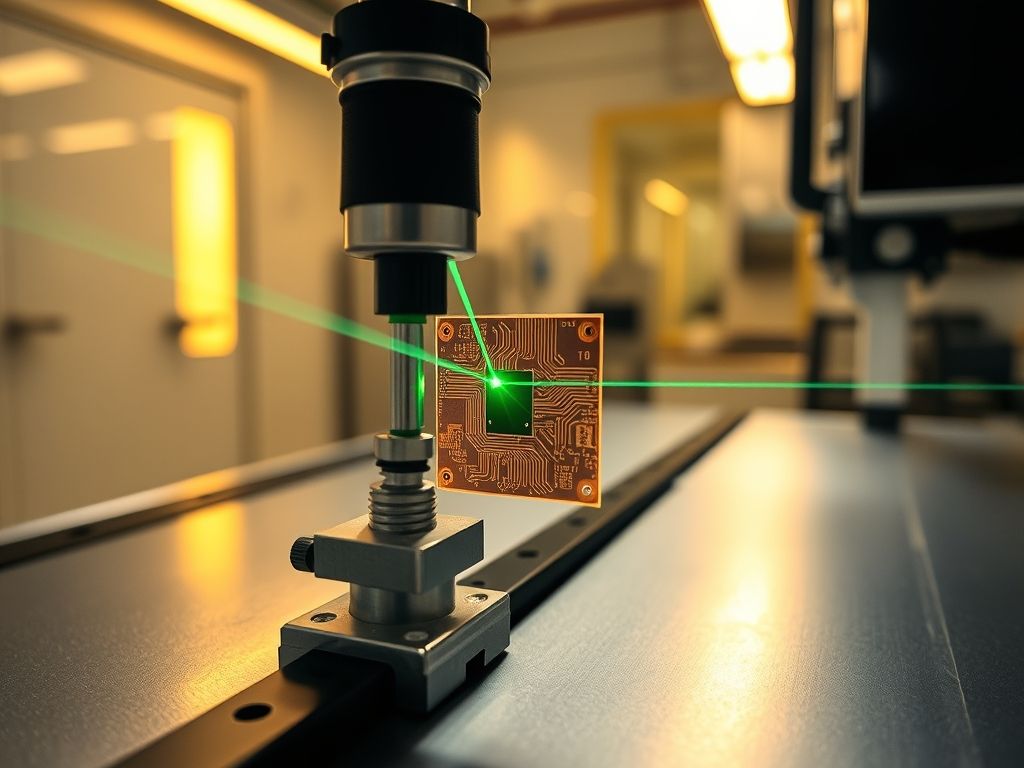
- Green lasers (515-532 nm): much better absorption in copper and gold — critical for batteries, power electronics and e-mobility
Which high power lasers Netherlands manufacturers prefer and why?
For high power lasers in the Netherlands, the pattern is clear:
In general machinebouw and toeleveranciers in Noord-Brabant, Overijssel and Gelderland, 3 to 12 kW fiber dominates new laser cutting systems for steel and aluminium. Lower maintenance and higher electrical efficiency fit Dutch energy prices and 24/7 schedules.
Around Brainport Eindhoven, Delft and Twente, I see the opposite end of the spectrum: low-power but extreme-precision ultrafast and single-frequency sources for R&D, MedTech and the ASML ecosystem. According to PhotonicsNL, the Dutch photonics ecosystem includes more than 300 companies, knowledge institutes and supply chain partners concentrated around Eindhoven, Delft and Twente. That density explains why ultrafast demand here is higher than in most European regions.
You can browse typical architectures in this overview of lasers for research and industry.
| Laser type | Typical wavelength | Best for | Watch out for |
|---|---|---|---|
| Fiber (CW, kW) | ~1070 nm | Steel, stainless, aluminium cutting and welding | Reflective metals need back-reflection protection |
| CO2 | 10.6 µm | Wood, acrylic, textiles, glass, packaging | Higher maintenance, beam path purging |
| Direct diode | 800-980 nm | Cladding, hardening, plastic welding | Lower beam quality than fiber |
| Nd:YAG / Disk, pulsed | 1064 nm | Spot welding, drilling | Lamp-pumped versions are less efficient |
| Ultrafast pico/femto | 1030 / 515 / 343 nm | Micromachining, medical, semiconductors | Higher capex, needs clean environment |
| Green / Blue | 515 / 450 nm | Copper, gold, batteries | Optics and process window are critical |
| Excimer / UV | 193-355 nm | Lithography, PCB, polymers | Gas handling and service expertise needed |
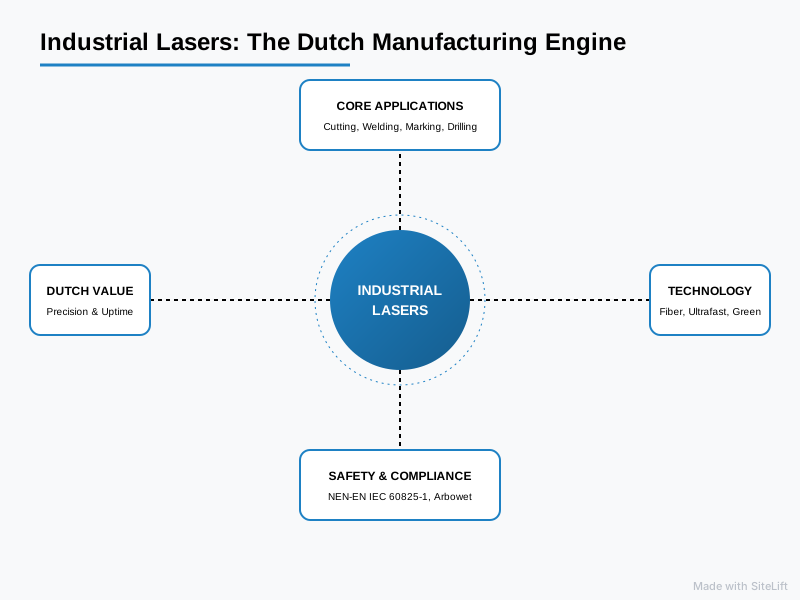
Infographic by SiteLift
Pro Tip: Bring real samples to a demo — brushed, coated, anodized, oily. Catalogue cut speeds are measured on perfect sheets. Your factory is not a catalogue.
What Are the Key Industrial Laser Applications in Dutch Manufacturing?
According to the European Commission, photonics is designated as one of six Key Enabling Technologies essential for Europe’s industrial competitiveness and digital transition. In the Netherlands you feel that directly on the shop floor.
How do laser cutting systems drive Dutch sheet metal and high-tech industries?
Laser cutting systems are the entry point for most Dutch job shops. A 6 kW fiber flatbed with automation can cut 1-20 mm mild steel, stainless and aluminium all day, switch to tube cutting with a rotary axis, and hold tolerances that make bending and assembly predictable.
Typical Dutch use cases I see:
- Cabinet building, agricultural machinery and food-processing equipment in stainless 304/316
- Machine frames and brackets where laser-cut accuracy reduces welding rework
- Thin-sheet high-mix work for Brainport suppliers, where quick changeover beats raw speed
Nitrogen fusion cutting gives oxide-free edges for powder coating. Oxygen cutting is cheaper for thick mild steel but leaves oxide you must grind before welding.
How are lasers used for welding, marking, engraving and drilling?
Laser welding is growing fast in the VDL Nedcar supply chain, e-bike and e-mobility workshops, and battery pack builders. Fiber and diode lasers weld dissimilar thicknesses with low distortion — ideal for enclosures, busbars and cooling plates.
Laser marking and engraving solve traceability. Food, pharma and semiconductors need permanent, chemical-free codes: DataMatrix, UDI, serials, logos. Fiber marks metals, CO2 and UV mark plastics, glass and labels without ink.
Laser drilling and texturing cover filters, sieves, injection nozzles and surface functionalisation for better adhesion or hygiene.
If you handle Class 3B or 4 open beams during integration, proper eyewear is non-negotiable. Dutch integrators often source laser safety goggles based on coated or absorptive filters matched to the exact wavelength and optical density.
What role do lasers play in additive manufacturing, microprocessing and photonics R&D?
Beyond the factory floor, industrial lasers drive Dutch innovation:
- Additive manufacturing: powder-bed fusion and directed energy deposition for lightweight aerospace and MedTech parts
- Cladding and hardening: extend life of tools, shafts and agricultural wear parts
- Microprocessing: dicing, scribing and via drilling for chips, sensors and photonics integrated circuits
- Photonics R&D: TNO, TU Delft, University of Twente and TU/e use tunable, narrow-linewidth and ultrafast sources for quantum, lidar and integrated photonics. The Netherlands Organisation for Applied Scientific Research shares examples of this high-tech manufacturing work on TNO.
That mix — heavy steel one street away from a quantum lab — is very Dutch. Your supplier should speak both languages.
How to Choose the Right Industrial Laser for Your Facility in the Netherlands?
Do not start with watts. Start with your part.
What material, thickness and throughput requirements matter most?
Map these four points before you request a quote:
- Material and finish: mild steel, stainless, aluminium, copper, brass, titanium, plastics, glass? Reflective metals push you to fiber with back-reflection protection or green/blue.
- Thickness range and edge quality: 1 mm enclosures vs. 25 mm base plates are different machines.
- Throughput and mix: 24/7 single part or high-mix with 20 changeovers per day? Automation, pallet changers and software matter more than peak power for high-mix.
- Environment: cleanroom and vibration control for microprocessing, versus dust, oil mist and forklifts on a factory floor.
How to evaluate power, beam quality, integration and total cost of ownership?
Power without beam quality is just a heating bill. A 4 kW single-mode fiber can outcut a 6 kW multimode on thin sheet because the spot is smaller.
Checklist I give Dutch buyers:
- Beam quality M², focusability and cutting head — not just kW on the brochure
- Chiller, fume extraction and power supply — often 15-25% of project cost
- CNC / robot / PLC integration — EtherCAT, PROFINET, OPC-UA for Smart Industry
- Optics lifetime and spare parts lead time — lenses, nozzles, protective windows
- Service response in hours, not days — can an engineer be in Eindhoven, Rotterdam or Zwolle tomorrow?
- Energy use and duty cycle — fiber and diode win on kWh per part
- Software: nesting, monitoring, predictive maintenance logs
A mid-range fiber laser cutting system in the Netherlands typically sits in the low six figures in euros before automation and extraction, while high-power automated cells and ultrafast micromachining stations run significantly higher. Treat any online price as a starting point — integration, safety enclosure and service contract define the final ROI.
When to partner with a Dutch photonics supplier like Te Lintelo Systems?
Single-brand vendors sell you their laser. An independent photonics partner helps you choose between manufacturers, validates the process on your materials, and stays responsible for optics, metrology and safety after installation.
Look for local demo facilities, Dutch-language support, calibration capability and a broad manufacturer network. For specialised solid-state needs, for example, it helps that a partner can access portfolios like Photonics Industries International, pioneer of intra-cavity solid-state harmonic lasers.
The European Photonics Industry Consortium is a useful neutral source for market reports and technology trends if you want a second opinion beyond vendor claims.
How to Ensure Laser Safety, Maintenance and Compliance in the Netherlands?
High power is only useful if it is safe and stable.
What are the NEN-EN IEC 60825-1 laser safety classes and employer obligations?
The Netherlands uses NEN-EN IEC 60825-1, aligned with international laser safety standards published by the International Organization for Standardization system and IEC. In practice:
- Class 1: safe under normal use (enclosed cutter, CD player)
- Class 1M, 2, 2M: low risk but do not stare into beam or use magnifying optics
- Class 3R, 3B: direct viewing hazardous, controls required
- Class 4: cutting, welding and most processing lasers — fire, skin and eye hazard, fumes, reflections
Under the Dutch Arbowet, the employer must perform an RI&E risk assessment, implement engineering controls first, and only then rely on PPE. That means enclosed Class 1 cells with interlocks, beam shutters, key switches, warning lights, fume extraction and documented procedures. Appoint a trained Laser Safety Officer for Class 3B and 4 installations and register training.
The Laser Institute of America offers practical guidance on laser safety standards, training and industrial applications that aligns well with Dutch practice.
What does preventive maintenance and calibration involve?
Industrial lasers last a long time — fiber sources often run tens of thousands of hours — but optics, chillers and motion systems decide uptime.
My preventive baseline:
- Daily: check protective windows, nozzles, extraction flow
- Weekly: clean optics with correct protocol, check cooling water level and filters
- Monthly: verify power with calibrated meter, check beam alignment and focus position
- Yearly: full calibration, chiller service, safety interlock test, software backup
Use light metrology for quality control, not gut feel. Log power, cut edge roughness and weld penetration so you spot drift before scrap. Negotiate service contracts with guaranteed response times and local spare stock if you run 24/7.
What Is the Future of Industrial Lasers in Dutch Smart Industry?
The next five years in the Netherlands are less about more watts and more about smarter photons.
How will Industry 4.0, automation and AI shape laser processing?
I already see Dutch integrators pairing lasers with robotics, 3D vision and digital twins in Smart Industry fieldlabs. Cameras measure the seam in real time, AI adjusts power and speed, and every part gets a digital passport with marking data. For high-mix Brainport suppliers, that closed loop is worth more than another kilowatt.
Expect more compact, fully enclosed Class 1 workstations that operators can run without laser goggles, plus plug-and-play interfaces to MES and ERP.
Why is sustainability and energy efficiency driving fiber and diode adoption?
Energy prices and circular manufacturing goals push Dutch factories toward efficient sources. Fiber and diode lasers waste less electricity as heat, need less cooling, and enable repair through cladding instead of replacement. Green and blue lasers unlock copper welding for batteries and power electronics without exotic processes. Ultrafast lasers enable miniaturisation — smaller sensors, less material, longer product life.
The Dutch national photonics cluster connects much of this activity, from Holland High Tech roadmaps to PhotonicsNL growth programs. If you are planning a 5-10 year investment, align your choice with that ecosystem, not just this year’s order book.
My Take: Why Buying on Spec Sheets Fails in the Netherlands
I will be blunt, because I have seen this mistake too often in Brabant and Twente.
Most top-ranking guides for industrial lasers read like translated brochures from global giants. They list kilowatts and feed rates but never tell you who services the chiller in Enschede, whether your 1970s factory has the power connection for 12 kW, or how the Arbo-inspectie will judge your open Class 4 cell.
In my experience, Dutch success with lasers comes from three unsexy things: honest process tests on your dirtiest material, a local engineer who picks up the phone, and measured data — power logs, edge quality, uptime — instead of promises.
I also think we underrate independence. A vendor will always conclude you need their wavelength. An independent advisor like Te Lintelo Systems, active since 1985 across lasers, optics and metrology, can tell you when a cheaper diode or a different pulse duration solves the job. That saves more money than haggling 5% off the machine.
If you take one thing from this guide: automate the handling before you maximise the watts. A 6 kW system running unmanned all night beats a 12 kW hero that waits for an operator.
— tlsbv.nl
Where to Get Independent Laser Advice in the Netherlands
Choosing between fiber, CO2, diode and ultrafast is not a catalogue exercise. It is a process test, an integration plan and a service commitment.
Te Lintelo Systems (tlsbv.nl) has connected Dutch research and industry with world-leading photonics manufacturers since 1985 — from light emission and beam delivery to detection and metrology. If you are evaluating laser cutting systems, high power lasers in the Netherlands, or precision sources for lab and fab, talk to a team that can compare options, arrange demos and support you in Dutch after commissioning.
Bring your drawings, your worst-case materials and your throughput targets. The right industrial lasers choice should lower your cost per part from day one, not just look impressive on the factory floor.
FAQ
What is an industrial laser and how is it different from other lasers?
An industrial laser is a laser built for continuous production use — cutting, welding, marking, drilling, cladding or microprocessing. Compared to pointers or lab lasers, industrial lasers offer much higher power and stability, rugged packaging for factory environments, and interfaces for CNC, robots and safety interlocks. They are specified by wavelength, power, beam quality M² and pulse duration rather than just colour or brightness.
Which type of industrial laser is best for metal cutting in manufacturing?
For most Dutch metal cutting, fiber lasers are the best all-rounder. They cut mild steel, stainless steel and aluminium fast, with low maintenance and high energy efficiency. CO2 remains useful for non-metals and special cases, while green and blue lasers are better for highly reflective copper and gold. For ultra-precise thin foils, medical parts or semiconductors, ultrafast picosecond or femtosecond lasers give cleaner edges with minimal heat damage.
How much does an industrial laser cutting system cost in the Netherlands?
Cost depends on power, working area, automation, extraction and safety enclosure, not just the laser source. An entry-level fiber laser cutting system for thin sheet starts in the low six figures in euros, while high-power systems with pallet changers, tube cutting and full automation cost several times more. Ultrafast micromachining cells are priced on precision and integration rather than kilowatts. Always compare total cost of ownership — energy, optics, service and uptime — and get a process test on your own materials.
What safety regulations apply to high power lasers in the Netherlands?
High power lasers fall under NEN-EN IEC 60825-1, which defines Classes 1 to 4. Most open processing lasers are Class 4 and must be enclosed to Class 1 with interlocks, warning systems and fume extraction. Under the Dutch Arbowet, employers must carry out a risk assessment (RI&E), implement technical and organisational controls, provide wavelength-matched laser safety eyewear where needed, and appoint a trained Laser Safety Officer for Class 3B and 4 use.
How long do industrial lasers last and what maintenance do they need?
Fiber and diode sources typically last tens of thousands of operating hours, often many years in single-shift use. Lifetime depends more on optics, chillers and operating conditions than on the source itself. Plan for regular cleaning and replacement of protective windows and lenses, chiller filter changes, beam alignment checks, power calibration with traceable meters, and annual safety testing. A local service contract with spare parts stock is the most effective way to avoid unplanned downtime.