
Navigating Optical Components: Selecting the Right Lenses and Mirrors for R&D Labs
Choosing the right optical components can make or break an experiment. I have seen Dutch R&D teams lose weeks to a hazy beam profile or a coating that burns at half power, all because a catalogue lens looked “good enough.”
This list covers the 5 decisions I walk through with every lab, from substrate to surface quality. I evaluated each step for lab performance, wavelength compatibility, damage resistance, and how easy it is to source and support in the Netherlands.
1. Define Your Wavelength and Select Optical Components Substrate Material
What it is: The foundation rule for all optical components. Every glass transmits well in one band and absorbs in another. Match substrate to your laser or broadband source first, then worry about shape and coating.
Who it’s best for: Any lab building or upgrading a setup around a fixed laser line — HeNe at 632.8 nm, Nd:YAG at 1064 nm, Ti:Sapphire tunable around 700-1000 nm, or UV excimer sources.
Standout strength: Getting this right saves money everywhere else. A correct substrate gives you high transmission without exotic coatings.
Main drawback: High-performance UV and IR materials cost more and have longer lead times than standard visible glass.
UV, Visible, and IR Transmission Ranges
- N-BK7: The workhorse for visible light. It transmits well from roughly 350 nm to 2.0 µm, with excellent homogeneity and low cost. Ideal for imaging, alignment, and low-to-medium power visible lasers.
- UV Fused Silica: My default for UV work and high-power lasers. It transmits down to about 180 nm, has very low thermal expansion, and handles thermal load far better than N-BK7.
- Calcium Fluoride (CaF2) and Silicon / Germanium: For deep-UV to mid-IR. CaF2 covers ~130 nm to 10 µm but is brittle and sensitive to thermal shock. Silicon and germanium are for IR imaging and spectroscopy beyond 1.2 µm.
Comparing Fused Silica, N-BK7, and Calcium Fluoride
For labs at TU Delft, TU Eindhoven or TNO working across wavelengths, I usually recommend N-BK7 for prototypes and teaching setups, and fused silica for anything UV or high-fluence. The Dutch photonics network centred around PhotonDelta’s integrated photonics ecosystem keeps pushing more work into visible and near-IR PIC characterization, where thermal stability matters as much as transmission.
Pro Tip: If your lab temperature swings more than ±1°C, choose fused silica even for visible high-stability interferometry. Its near-zero thermal expansion keeps focus from drifting overnight.
2. Evaluate Optical Lenses Netherlands Options: Focal Length, Shape, and Aberration Control
What it is: Selection of focusing and collimating precision optics — singlets, achromats, and aspheres — with the right focal length and aberration correction for your beam size and detector.
Who it’s best for: Microscopy, beam delivery, spectroscopy, and PIC fibre-coupling labs sourcing optical lenses netherlands wide who need local advice on tolerances, not just a part number.
Standout strength: A well-chosen achromat or asphere shrinks your focal spot dramatically and cleans up imaging contrast.
Main drawback: Low-cost singlets introduce spherical aberration fast at low f-numbers, which ruins coupling efficiency.
Singlets vs. Achromatic Doublets
A plano-convex singlet is cheap and fine for simple focusing at f/5 and slower. Push faster, or use broadband light, and you will see spherical and chromatic aberration blur your spot.
Achromatic doublets bond two glasses to correct colour and reduce spherical error. I use them for fluorescence microscopy, spectrometer input optics, and white-light interferometry. For diffraction-limited focusing of a collimated laser, an aspheric lens is worth the premium — one asphere can replace two spherical elements.
Sourcing High-Quality Optical Lenses in the Netherlands
Catalogue specs never tell the full story on centration, edge chips, or coating batch variation. That is where local engineering support helps. When you browse the optical components range with lenses, mirrors and prisms, ask for measured wavefront data and coating curves at your actual angle of incidence, not just normal incidence.
Pro Tip: For fibre coupling 1550 nm into single-mode fibre, switch from a 11-mm asphere with NA 0.25 to a properly coated moulded asphere with NA 0.4. Coupling can jump from 40% to over 70% with no other change.
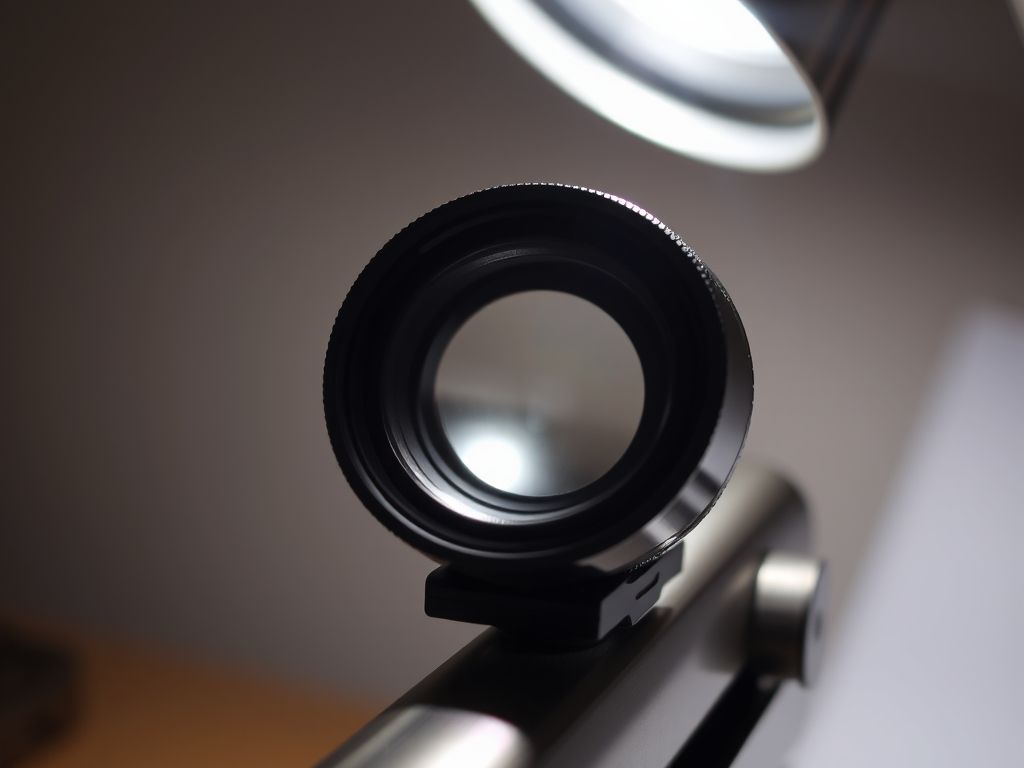
3. Choose the Right Optical Mirrors for Your Optical Components Setup
What it is: Beam steering and cavity optics where reflectivity, flatness, and Laser Damage Threshold (LDT) determine survival.
Who it’s best for: High-power laser labs, ultrafast groups, and interferometry setups where wavefront distortion shows up immediately in data.
Standout strength: The right mirror preserves power and beam quality with almost no loss.
Main drawback: Ultra-high reflectivity always means narrow bandwidth and strict angle limits. Versatility and peak performance trade off.
Metallic vs. Dielectric Coatings
- Protected aluminium: Broad 450 nm – 20 µm coverage, ~90-92% reflectivity. Tough and cheap for alignment.
- Protected silver: ~96-98% across visible and NIR. My go-to for broadband spectroscopy and imaging relays.
- Gold: Excellent >96% from 800 nm into IR. Standard for CO2 and telecom IR beamlines.
- Dielectric HR: Routinely exceeds 99.9% reflectivity at the design wavelength, according to design principles detailed in Optica’s optics and photonics technical resources. Best for laser cavities, periscopes with multiple bounces, and low-loss delay lines.
With four bounces, the difference is brutal: 98% mirrors leave you 92% throughput, 99.9% mirrors leave you 99.6%.
Managing Laser Damage Threshold (LDT)
LDT is the fluence a coating survives, usually quoted in J/cm² for ns pulses or W/cm² for CW. Always de-rate catalogue LDT by 2x for real labs — dust, slight misalignment, and hot spots lower it. Dielectrics generally handle high peak power better than metals, but only at their design wavelength and angle.
Check pulse duration scaling, spot size (1/e²), and repetition rate. If your supplier cannot provide ISO-tested LDT data at your wavelength, do not use that mirror above 1 W CW.
4. Specify Custom Optical Coatings for Enhanced Performance
What it is: Tailored anti-reflective (AR), high-reflective (HR), beamsplitter, and filter coatings that make standard substrates perform like precision optics built for your experiment.
Who it’s best for: R&D teams using multiple laser lines, odd angles of incidence, or vacuum / cleanroom environments where stray light kills SNR.
Standout strength: A good coating often improves system performance more than upgrading the glass itself.
Main drawback: Custom runs add 4-8 weeks lead time and minimum order quantities.
Anti-Reflective (AR) vs. High-Reflective (HR) Coatings
Uncoated N-BK7 reflects ~4% per surface. In a 6-element train, you lose over 35% to Fresnel loss and ghosts. A broadband AR stack drops that to <0.5% per surface across 400-700 nm. For single laser lines, a V-coat can hit <0.1%.
HR coatings do the opposite. Ion-beam-sputtered (IBS) dielectric stacks give lowest scatter and highest LDT for 266 nm, 532 nm, 1064 nm and telecom bands. Guidance on coating design trade-offs is well summarised in SPIE’s optics and photonics application resources.
The Value of Custom Optical Coatings for Specialized R&D
Off-the-shelf cannot cover dual-line 532/1064 nm with 45° AOI, or low-polarization-splitting beamsplitters for quantum optics. That is why so much advanced work goes custom. The European photonics community consistently reports that well over half of advanced R&D builds need custom-designed optics rather than catalogue parts to meet experimental requirements — a trend driven by medical, quantum, and industrial lasers needing custom optical coatings.
I always co-design coating, substrate, and AOI together. A coating optimised for 0° used at 45° can shift 50 nm and halve your transmission.
5. Understand Surface Quality and Mechanical Tolerances in Precision Optics
What it is: The fine print on European optical drawings — surface figure, scratch-dig, and mechanical fit — that determines whether your precision optics actually perform as modelled.
Who it’s best for: Interferometry, high-power, and imaging labs where scatter, wavefront error, or a loose mount shows up as noise.
Standout strength: Tight specs deliver repeatable, publishable data and protect high-power coatings.
Main drawback: Over-specifying everywhere doubles cost and lead time for zero visible gain.
Decoding ISO 10110 Standards
Dutch labs work to ISO 10110, not just US MIL specs. Key callouts:
- Surface figure: λ/10 @ 633 nm is excellent for general laser work. Choose λ/20 or better for interferometry reference flats and cavity mirrors.
- Surface imperfection: 5/3×0.04 means max 3 imperfections of 0.04 mm. Lower numbers = less scatter.
- Centration and wedge: Critical for lens doublets in imaging systems.
Practical background on applied optics tolerances is available through TNO’s expertise in optics and optomechatronics.
Scratch-Dig Specifications for High-Precision Applications
- 40-20: Fine for general imaging, illumination, and prototyping.
- 20-10: My baseline for visible lasers and fluorescence.
- 10-5: Essential for high-power, UV, and intracavity optics. Dig sites become damage precursors under intense pulses.
Do not forget mechanics. Specify diameter +0/-0.1 mm, thickness ±0.1 mm, and clear aperture >90% for mounted fibre-coupled and free-space photonics products. A λ/10 mirror in a stressed aluminium mount becomes λ/4 quickly.
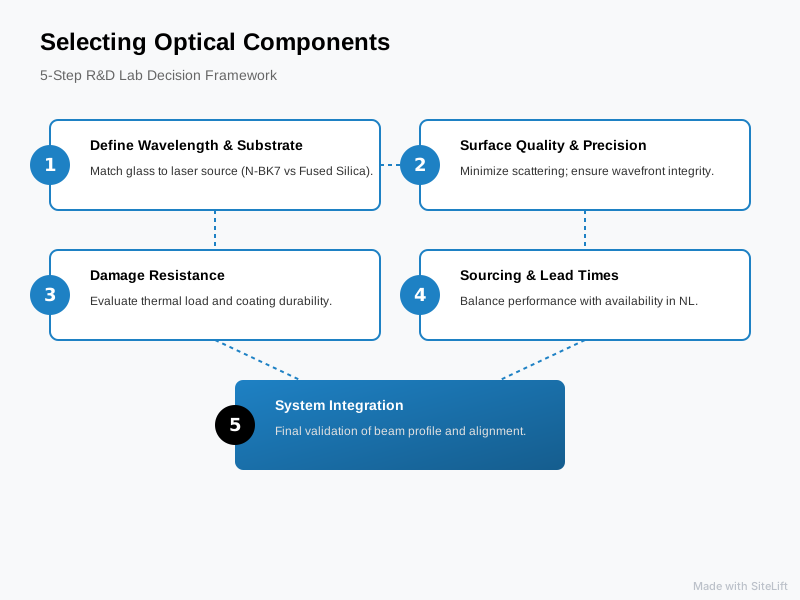
Infographic by SiteLift
Summary Comparison: Quick-Reference Selection Matrix for R&D Procurement
Here is how I map applications to optical components choices before requesting a quote:
| Application | Recommended Substrate | Lens / Mirror Type | Coating | Surface Spec |
|---|---|---|---|---|
| Fluorescence microscopy | N-BK7 | Achromatic doublet, NA 0.3-0.6 | Broadband AR 400-700 nm | 40-20, λ/4 |
| UV spectroscopy 250-400 nm | Fused silica | Singlet or air-spaced doublet | UV AR V-coat | 20-10, λ/10 |
| 1064 nm high-power delivery | Fused silica | Asphere + dielectric HR mirrors | HR 1064 nm + AR 1064 nm, high LDT | 10-5, λ/10 |
| Telecom PIC coupling 1550 nm | Fused silica / Si | Moulded asphere, gold mirror for IR | AR 1500-1600 nm | 20-10, λ/10 |
| Interferometry / quantum | Fused silica / Zerodur | λ/20 flats, low-loss beamsplitter | Custom IBS low-scatter | 10-5, λ/20 |
If you work across several rows, standardise on fused silica and IBS coatings. Inventory gets simpler and re-use gets easier.
Final Verdict: How to Choose Without Overpaying
My take after years supporting labs from Twente to Delft: most teams overthink lens shape and underthink coatings and surface quality.
If I had to rank impact per euro: 1) correct substrate for wavelength, 2) custom optical coatings tuned to your AOI, 3) surface figure and scratch-dig matched to power level, 4) asphere vs. achromat last.
For a teaching setup, catalogue N-BK7 40-20 optics are perfect. For publishable interferometry, single-molecule imaging, or anything above 5 W, go custom fused silica 20-10 or 10-5 with tested LDT. And always prototype the full beam path on paper — count every surface loss before you buy.
In my experience, the most underrated upgrade is not a more expensive lens, it is a properly specified AR coating at the correct angle. Stray light drops, contrast jumps, and your detector noise floor suddenly looks much better.
Where to Get Local Help in the Netherlands
Catalogue giants are fine for next-day singlets, but they cannot co-design a dual-wavelength IBS stack or troubleshoot a burnt mirror with you in the lab. That gap is exactly why local photonics partners exist.
Browse the full range of photonics technologies and tailored solutions to see what can be combined — lenses with matched mirrors, windows, and fiber delivery — then talk through tolerances with an engineer who knows ISO 10110 drawings.
For teams that want that bridge between world-leading manufacturers and daily lab reality, tlsbv.nl has supported Dutch research and industry since 1985 with light emission, manipulation, and detection expertise.
— tlsbv.nl
FAQ
What is the difference between N-BK7 and Fused Silica for optical lenses?
N-BK7 is a cost-effective borosilicate crown glass for 350 nm to 2 µm. It offers excellent homogeneity for visible imaging and low-power lasers. Fused silica transmits deeper into UV to ~180 nm, has much lower thermal expansion, and resists laser damage better, making it ideal for UV, high-power, and thermally stable precision optics.
How do custom optical coatings improve the efficiency of R&D laser systems?
Uncoated glass loses ~4% per surface. Custom optical coatings cut AR loss to <0.5% broadband or <0.1% V-coat, and boost HR mirrors above 99.9%. Custom designs also handle multiple laser lines and specific angles of incidence, reducing stray light and preserving power through complex trains.
What surface flatness tolerance do I need for high-precision interferometry?
Use λ/20 or better at 633 nm for reference flats, cavity mirrors, and interferometer beamsplitters. General laser steering works well at λ/10. Anything worse introduces wavefront error that shows up directly as fringe distortion and measurement uncertainty.
Where can I find reliable suppliers for custom optical lenses in the Netherlands?
Look for B2B photonics partners that offer ISO 10110 drawings, coating curves at your AOI, and LDT test data — not just catalogue listings. Local distributors connected to PhotonDelta and Dutch universities, with in-house engineering support for optical lenses netherlands projects, shorten lead times and help with custom specs and mounting.
What is Laser Damage Threshold (LDT) and why does it matter for optical mirrors?
LDT is the maximum laser fluence (J/cm² pulsed, W/cm² CW) a mirror coating survives without damage. Exceed it and the coating burns, scatters, or delaminates. Always match LDT to your wavelength, pulse length, spot size, and angle, and de-rate catalogue values by ~50% for dust and real-world hot spots.