
He Ne Laser Basics: Why Helium-Neon Lasers Still Matter in Dutch Research
Walk through the cleanrooms of Brainport Eindhoven or the optics laboratories at TU Delft, and you will spot a familiar crimson glow tracing its way across isolated optical breadboards. More than six decades after Ali Javan, William R. Bennett Jr., and Donald Herriott developed the first gas laser at Bell Labs, the he ne laser remains an indispensable standard in precision photonics. While compact semiconductor diodes have captured high-volume consumer markets, modern experimental physics, lithography metrology, and dimensional calibration still rely on the gas-discharge tube for ground-truth optical precision.
Semiconductor diodes drift with temperature, produce astigmatic elliptical beams, and require external cavity locking to achieve modest phase stability. By contrast, a gas-discharge system provides pristine spatial coherence straight out of the aperture. In high-stakes R&D environments across the Netherlands, precision is non-negotiable—and that continuous red beam continues to anchor cutting-edge optical architectures.
What Is a He Ne Laser and How Does It Operate?
To understand why this architecture endures, look at the microscopic physics inside the optical cavity. The he ne laser is a four-level gas laser that relies on a specific gas mixture—roughly ten parts helium to one part neon—confined within a sealed glass capillary tube at low pressure (typically a few millibars).
The Excitation Mechanism: Gas Mixture and Resonant Energy Transfer
Lasing action does not originate from direct electrical pumping of the neon gas. Neon atoms have complex electronic structures that make direct excitation inefficient. Instead, an electrical discharge running between an internal cold cathode and anode excites the lighter, more mobile helium atoms through electron impact.
Electrons (Discharge) ---> Helium (2¹S & 2³S Metasatable States)
                                  │
                       Resonant Energy Transfer
                       (Collisional Inelastic Pumping)
                                  │
                                  ▼
                             Neon (2s & 3s Levels)
                                  │
                                  ▼  Lasing Action (Photon Emission)
                             Neon (2p Levels)
                                  │
                                  ▼  Spontaneous Decay
                             Neon (1s Ground State)
Helium’s metastable excited energy states ($2^1S$ and $2^3S$) possess exceptionally long lifetimes and align almost perfectly with the $2s$ and $3s$ energy levels of neutral neon. When an excited helium atom collides with a ground-state neon atom, an inelastic resonant transfer occurs: helium transfers its stored energy to neon with near-zero kinetic energy loss. This resonant collision builds the population inversion required for optical amplification, allowing neon to transition between its $3s$ (or $2s$) levels down to lower $2p$ manifolds, releasing coherent photons during the process. The historical evolution of this mechanism is documented in foundational archives maintained by Optica.
Anatomy of the HeNe Laser Tube: Cathode, Anode, and Optical Cavity
The mechanical and optical construction of a modern HeNe laser tube demands extreme structural precision:
- Capillary Bore: A precision-drilled glass or ceramic bore (often 0.5 mm to 1.5 mm diameter) constrains the electrical plasma discharge, ensuring tight overlap between the excited gain medium and the fundamental optical mode.
- Cold Cathode: Constructed from aluminum or zirconium-coated cylinders, the cold cathode acts as a durable electron reservoir designed to withstand continuous ion bombardment without excessive material sputtering.
- Optical Resonator: Consists of a highly reflective (HR) rear mirror ($R > 99.9%$) and a partially reflective output coupler mirror (transmission typically $1%$ to $2%$).
- Cavity Enclosure: In internal-mirror designs, the mirrors are fused directly to the tube using glass-frit hard seals. For specialized external cavity setups, tubes use optical-quality Brewster windows cut at Brewster’s angle to deliver a polarized output beam without reflective losses.
The Spectrum: Helium Neon Laser Wavelength Options Beyond 632.8 nm
While the familiar 632.8 nm visible red transition dominates research benches, neon provides dozens of possible laser lines across the visible and infrared spectrum. By coating the cavity mirrors with dielectric stacks optimized for specific reflection bands, manufacturers suppress the dominant 632.8 nm line to isolate other optical transitions:
- 632.8 nm (Red): The quintessential reference line for alignment, holographic imaging, and standard interferometry.
- 543.5 nm (Green): Known colloquially as the “GreNe,” this line matches the peak sensitivity of human photopic vision, making it valuable for confocal microscopy and flow cytometry.
- 594.1 nm (Yellow): Used in ophthalmic diagnostic tools, cell sorting, and high-contrast optical instrumentation.
- 611.9 nm (Orange): Bridging yellow and red, this wavelength supports multi-line fluorescence metrology.
- 1152.3 nm & 3391 nm (Infrared): The original lines discovered in early Bell Labs experiments. The 3.39 µm transition features exceptionally high optical gain, frequently serving in methane gas detection and specialized optical radar applications.
Why He Ne Laser Gas Stability Still Outperforms Diode Alternatives
Engineers often ask why solid-state lasers or edge-emitting laser diodes have not rendered gas lasers obsolete. The answer lies in beam geometry and phase purity.
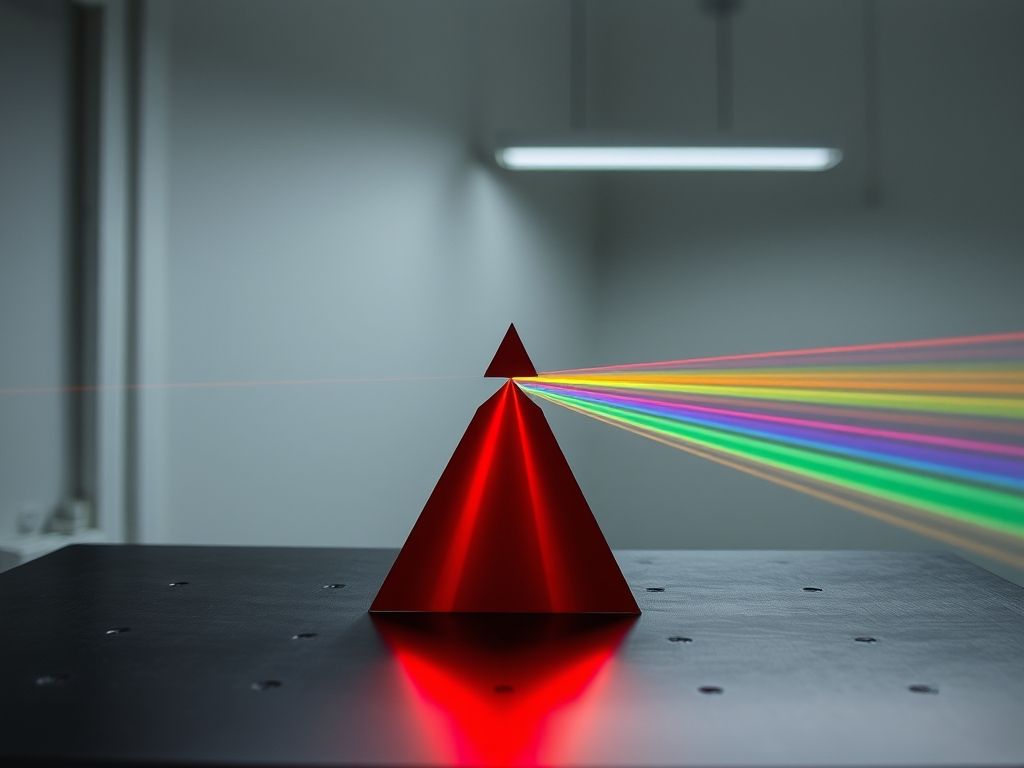
Spatial Coherence and Fundamental TEM00 Beam Profiles
A semiconductor laser diode emits light from an asymmetrical, sub-micron junction. This geometry introduces broad beam divergence, significant astigmatism, and high wavefront aberration that requires cylindrical anamorphic prism pairs or complex aspheric collimators to correct.
In contrast, a gas laser amplifies light within a macroscopic, cylindrical capillary waveguide. The resonator naturally selects the fundamental transverse electromagnetic mode ($text{TEM}_{00}$). This produces an almost mathematically ideal Gaussian intensity profile with beam propagation factors ($M^2$) routinely measuring below 1.05. When focused, the beam collapses down to a diffraction-limited spot without secondary sidelobes, a property required for spatial filtering and point-spread-function characterization.
Thermal and Frequency Stability in High-Precision Metrology
Because a gas laser’s active medium is a low-density plasma, its optical refractive index remains very close to unity. It does not suffer from the drastic carrier-density shifts and thermal expansion that destabilize semiconductor diode junctions.
Unstabilized helium-neon systems exhibit modest thermal cavity expansion, but frequency-stabilized systems deliver performance in another tier entirely. According to RP Photonics, stabilized Helium-Neon lasers can achieve frequency stabilities on the order of $10^{-11}$ and coherence lengths well beyond several tens of meters.
For international dimensional calibration, nothing matches an absorption-cell locked setup. Data published by NIST confirms that the standard iodine-stabilized 632.8 nm He-Ne laser serves as a primary international optical frequency and dimensional reference standard with an uncertainty below $2.5 times 10^{-11}$. Standard semiconductor diodes cannot approach this level of intrinsic long-term coherence without elaborate, failure-prone optical feedback loops.
Standard Diode:  [Coherence: ~1 mm to a few cm]
Extended Cavity: [Coherence: ~1 to 5 meters]
Stabilized He-Ne:[Coherence: Tens to Hundreds of Meters ─────────────────────────►]
He Ne Lasers vs. Diode and DPSS Sources: A Technical Trade-Off
| Optical Parameter | Helium-Neon Gas Laser | Red Diode Laser (Edge Emitter) | Diode-Pumped Solid-State (DPSS) |
|---|---|---|---|
| Beam Quality ($M^2$) | $< 1.05$ (Pristine $text{TEM}_{00}$) | $1.2 – 2.5+$ (Astigmatic, elliptical) | $1.1 – 1.3$ (Good circular profile) |
| Coherence Length | 0.2 m to $>100text{ m}$ (stabilized) | 1 mm to 10 mm (typ. unstabilized) | 1 mm to 10 m (model dependent) |
| Linewidth | $< 1text{ MHz}$ (free run) to $< 10text{ kHz}$ | Hundreds of MHz to GHz | $1text{ MHz}$ to tens of MHz |
| Wavelength Drift | Minimal ($sim 10^{-6}$ fractional) | High ($sim 0.3text{ nm}/^circtext{C}$) | Moderate thermal dependence |
| Footprint & Efficiency | Low efficiency, larger tube housing | Compact, high electrical efficiency | Compact, moderate efficiency |
| Warm-up Period | 10 to 30 minutes | Instantaneous ($< 1text{ s}$) | 5 to 15 minutes |
What Makes the He Ne Laser Crucial for Dutch Research and Industry?
The Netherlands features one of the most concentrated optics and nanometrology ecosystems in the world. As highlighted by PhotonDelta, the Dutch photonics ecosystem operates across academic frontiers and industrial applications. Within this environment, the he ne laser provides the operational baseline that supports complex commercial systems.
Essential Role as an Optical and Laser Alignment Source
In research labs across TU Delft, Eindhoven University of Technology (TU/e), and the University of Twente, multi-laser optical breadboards are the norm. Researchers routinely align invisible infrared femtosecond pulses, extreme-ultraviolet (EUV) beamlines, or deep-UV lasers using a visible red beam.
Because of its continuous pointing stability, minimal beam wander, and circular profile, the classic 632.8 nm beam serves as the default laser alignment source. When aligning multi-element optics, spatial light modulators, and microscope objectives, aligning the setup with a pristine HeNe beam prevents downstream geometric errors before activating higher-power, non-visible beams.
Interferometric Metrology in Semiconductor and Nanotech R&D
Nowhere is dimensional accuracy more vital than within the Brainport Eindhoven microelectronics cluster. Precision motion stages for lithography inspection require sub-nanometer positional feedback.
Engineers use heterodyne displacement interferometers powered by frequency-stabilized He-Ne cavities to measure multi-axis wafer stage position in real time. Because the vacuum wavelength of the 632.8 nm line is known to extreme accuracy, stage positions can be measured through fringe counting with zero mechanical contact. Any deviation in the source laser’s frequency translates directly into overlay error on silicon wafers. This makes stabilized HeNe lasers essential across OEM tool assemblies and Dutch tier-one semiconductor suppliers.
Academic Workhorses Across Dutch Universities and Applied Labs
Beyond stage metrology, Dutch laboratories deploy these gas lasers across varied testing regimes:
- Vibrometry and Non-Destructive Testing: Heterodyne optical vibrometers detect structural vibrations in composite materials for aerospace and automotive prototypes.
- Optical Component Profilometry: Characterizing the surface roughness, flatness, and transmissive wavefront distortion of lenses and mirrors down to $lambda/20$ tolerances.
- Fundamental Quantum Optics: Calibrating detectors, balancing Mach-Zehnder interferometers, and validating single-photon detectors where mode matching demands pristine spatial profiles.
How Do You Select and Integrate the Right He Ne Laser System?
Integrating a gas laser requires different electrical and optical precautions than plugging in a benchtop diode module.
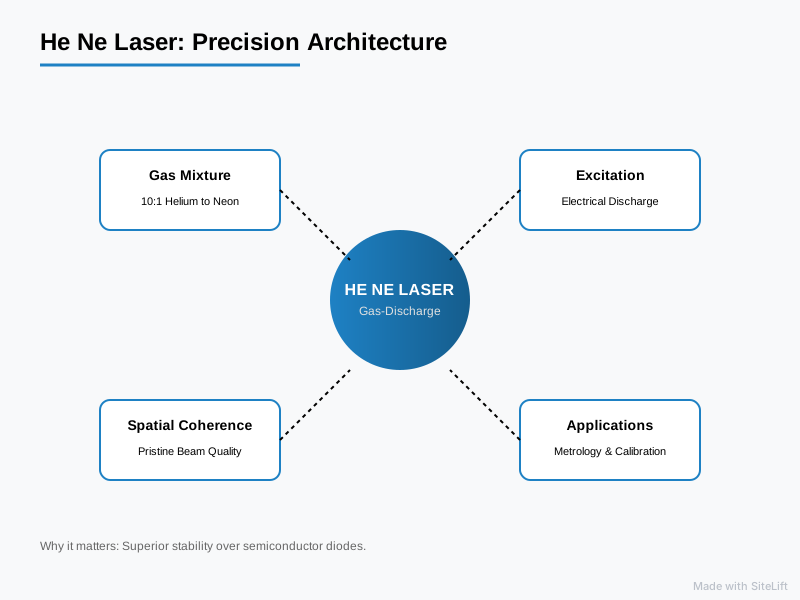
Infographic by SiteLift
Polarization Modes: Linear vs. Random Polarization
When browsing system specifications, you will encounter two primary polarization formats:
- Linearly Polarized Tubes ($> 500:1$ extinction ratio): These tubes contain an internal Brewster plate or mirror design that fixes the electric field vector along one orientation. Linear polarization is strictly required for polarization-sensitive interferometry, ellipsometry, and electro-optic modulation.
- Randomly (Unpolarized) Tubes: These systems emit light with an unpredictable, rapidly shifting polarization state caused by two orthogonal longitudinal modes competing for gain. While cheaper and well suited for broad laser alignment or transmission measurement, they can produce spurious amplitude noise (known as “polarization hopping”) when light reflects through polarizing optics.
Pro Tip: If your setup contains polarizing beamsplitters (PBS cubes), waveplates, or reflective optics mounted near normal incidence, always specify a linearly polarized tube. Using a randomly polarized source with a PBS creates severe downstream amplitude fluctuations that mimic laser power instability.
Power Considerations, Thermal Management, and Power Supply Matching
Output powers for commercial tubes range from 0.5 mW up to 35 mW. For general laboratory alignment, an eye-safe Class 2 or Class 3R laser ($0.5text{ to }1.0text{ mW}$) is preferred. High-precision interferometers and holographic testing rigs typically require 5 mW to 15 mW modules.
Powering these tubes requires care. They operate via cold-cathode gas discharge, meaning they require a high ignition voltage (typically $8text{ kV}$ to $12text{ kV}$) to ionize the helium-neon mix, followed by a continuous operating voltage between $1text{ kV}$ and $3text{ kV}$ DC.
[HV Power Supply] ───(+)───► [Ballast Resistor: 68kΩ - 100kΩ] ───► [Anode]
                                                                     │
                                                                 (Plasma)
                                                                     │
[HV Ground/Return] ◄───────────────────────────────────────────── [Cathode]
To stabilize this plasma discharge, an appropriate ballast resistor (typically $68text{ k}Omega$ to $100text{ k}Omega$) must be mounted in direct proximity to the anode lead. Running a tube without an impedance-matched ballast resistor creates high-frequency relaxation oscillations, causing output flicker and rapid tube degradation.
Mounting Best Practices to Protect Cavity Alignment and Lifespan
- Avoid Clamping Forces: Never clamp down on the center of a glass plasma tube. Mechanical stress will warp the internal capillary, destabilize the mirror alignment, and degrade the output power. Use purpose-built, dual-ring kinematic mounts with nylon-tipped set screws positioned at the designated mounting zones.
- Thermal Equilibration: Allow the laser tube to run for 15 to 30 minutes before taking critical metrology measurements. During warm-up, the tube expands by several micrometers, shifting the longitudinal cavity modes through the neon gain curve and creating cyclical power variations.
- Prevent Back-Reflections: The optical gain cavity is sensitive to retroreflections. Returning even $0.1%$ of the beam back into the capillary can disrupt the spatial mode structure and induce chaotic intensity noise. Tilt optical windows slightly off-normal or insert a Faraday optical isolator in precision paths.
What Is the Longevity and Maintenance Outlook for Helium-Neon Tubes?
A common misconception is that gas-discharge tubes are fragile components prone to frequent replacement. In reality, industrial-grade glass tubes provide decades of dependable service when operated within specification.
Understanding Operating Lifetimes: Hard-Seal vs. Soft-Seal Tubes
Earlier generations of gas lasers relied on optical epoxy to mount mirrors to the ends of the capillary—an approach known as “soft-seal” construction. These early tubes suffered from moisture ingress and atmospheric helium diffusion, limiting their shelf life to a few years.
Virtually all modern platforms use glass-frit or metal-to-glass “hard seals.” According to laser manufacturer specifications compiled by Laser Focus World, contemporary hard-seal HeNe plasma tubes deliver operational MTBF lifetimes ranging from 20,000 to over 40,000 continuous hours. When stored properly in dry, temperature-controlled conditions, their shelf life can easily exceed 15 years.
Diagnosing Common Failure Modes: Gas Cleanup and Mirror Degradation
If a laboratory tube underperforms or fails to strike an arc, inspect the physical symptoms:
- Discharge Color Shifts: A healthy discharge glows with an intense, bright orange-red plasma column. If the discharge appears pale pink, purple, or faint blue, air has leaked into the vacuum envelope, or cathode sputtering has consumed the neon gas.
- Cathode “Sputtering”: Over tens of thousands of operating hours, ion impacts knock metal atoms off the cold cathode surface. This redeposits a dark mirror-like film (a getter layer) on the inner glass walls. While the getter helps trap residual impurities, excessive sputtering eventually depletes the active gas mixture.
- High Voltage Flicker: If the beam periodically cuts out or the power supply repeatedly attempts to restrike the arc, the tube’s operating voltage has likely climbed above the power supply’s compliance limit due to internal gas pressure loss.
Pro Tip: If an unused spare tube fails to ignite on the first attempt, the internal gas mix may have suffered temporary charge separation. Let the power supply attempt to strike for 5 to 10 minutes; once the initial ionization cascade begins, the discharge often cleans up the path and stabilizes.
Sourcing and Replacing HeNe Components in the Benelux Region
For Dutch research institutions, sourcing direct drop-in replacements for aging optical tables can be a challenge. Major instrumentation suppliers often push to replace entire setups with diode arrays, even when downstream optics require the spatial beam quality of gas systems.
Replacing or retrofitting a tube within existing optomechanics is straightforward when you partner with specialized distributors. Precision-matched units from established manufacturers, including LASOS Laser Systems, allow research teams to retain their high-resolution beam trains without re-engineering their entire optomechanical layout.
Key Takeaways
| Feature / Consideration | Helium-Neon Gas Laser Platform | Application Advantage |
|---|---|---|
| Primary Wavelengths | 632.8 nm (Red), 543.5 nm (Green), 1152 nm (IR) | Standard international calibration references |
| Spatial Beam Quality | $M^2 < 1.05$, near-perfect Gaussian $text{TEM}_{00}$ | Instant, clean spatial filtering and high alignment precision |
| Operational Lifetime | 20,000 to 40,000+ hours (hard-sealed mirrors) | Decades of stable, drift-free laboratory service |
| Coherence & Linewidth | Tens of meters; stable narrow optical linewidth | Unmatched foundation for long-baseline interferometry |
| Integration Demands | High voltage power supply, thermal warm-up time | Simple passive heat sinking; no thermoelectric cooling required |
Why the Classic He-Ne Tube Remains Underrated on Modern Optical Tables
In an industry driven by continuous miniaturization and chip-scale photonics, it is easy to view glass gas tubes as relics of early quantum electronics. But looking at raw beam quality tells a different story.
Semiconductor diodes are remarkable components, but they are driven by market demands that prioritize compact size and raw milliwatt-per-euro metrics over spectral purity. When you spend months troubleshooting interference fringe drift, astigmatic wavefront errors, or mode-hopping artifacts in a custom sensor rig, you quickly appreciate the elegance of a laser medium that relies on atomic gas physics rather than doped semiconductor junctions.
On an optical breadboard, a dependable he ne laser simply works. It delivers an unblemished, circularly symmetric beam the moment you turn on the high-voltage supply. For advanced metrology, lithography validation, and fundamental optics research across the Netherlands, this mature platform remains the reference standard that keeps complex photonics projects running smoothly.
— tlsbv.nl
Need Support Integrating Gas Lasers or Precision Optics?
Navigating laser selection across complex Dutch research environments requires dedicated technical insight. Whether you are upgrading an interferometric metrology rig in Eindhoven, sourcing a specialized green gas laser tube for microscopy, or replacing legacy laser assemblies at an academic institution, Te Lintelo Systems (TLS) brings decades of practical photonics expertise to your workspace.
Our engineers collaborate directly with optical design teams to specify the ideal laser tubes, solid-state alternatives, optical components, and detection electronics for your precision applications.
Frequently Asked Questions
What is the primary helium neon laser wavelength used in laboratories?
The primary and most widely recognized wavelength is 632.816 nm in air, which produces an intense visible red beam. Other available neon transitions include 543.5 nm (green), 594.1 nm (yellow), 611.9 nm (orange), and several infrared lines, including 1152.3 nm and 3391 nm.
Why choose a He Ne laser over a red diode laser for interferometry?
A he ne laser provides superior spatial coherence, a symmetrical circular beam profile ($M^2 < 1.05$), and a much longer coherence length (ranging from tens of centimeters to tens of meters in stabilized models). Red diode lasers emit an elliptical, astigmatic beam with high phase noise and thermal drift, which degrades fringe contrast in long-path interferometric metrology.
How long does an industrial HeNe laser tube typically last?
Modern hard-sealed plasma tubes deliver an operational mean time between failures (MTBF) ranging from 20,000 to over 40,000 continuous hours. Stored properly within standard environmental limits, their operational shelf life routinely exceeds 10 to 15 years.
What is the difference between linearly and randomly polarized He-Ne lasers?
Linearly polarized systems include an internal polarizing element (such as an internal Brewster surface) that fixes the beam’s polarization vector to a ratio of 500:1 or greater, which is necessary for polarization-sensitive metrology. Randomly polarized tubes emit two orthogonal polarization states that fluctuate rapidly, making them suitable for non-polarized applications like beam alignment or optical particle scattering.
Why are He-Ne lasers still preferred as a laser alignment source on optical tables?
Unlike diode modules, which often require external anamorphic prisms to correct their beam shape, gas tubes emit a circular Gaussian beam directly from the aperture with very low divergence and high pointing stability. This enables researchers to align complex multi-mirror setups accurately before activating high-power, invisible UV or infrared beams.