
Helium Neon Gas and Lasers: Properties, Safety and Photonics Uses Explained
When solid-state diodes surged into the market decades ago, many technicians predicted the end of gas lasers. Yet, walk into any high-precision cleanroom in Brainport Eindhoven or an optical metrology lab at TU Delft, and you will almost certainly spot the familiar, unmistakable warm red glow of a helium neon laser.
Despite the compact footprint of modern semiconductor sources, the helium-neon (HeNe) laser remains an irreplaceable gold standard in optical physics. Its spatial coherence, thermal stability, and beam geometry provide performance characteristics that solid-state alternatives struggle to match.
Whether you are configuring an alignment bench or designing high-end interferometry equipment, understanding how the helium-neon architecture operates—from the mechanics inside the discharge tube to international safety regulations—is essential for any photonics engineer.
What is Helium-Neon and How Does Gas Laser Physics Work?
To understand why this laser works so reliably, you have to look at the atomic interplay inside the cavity. A HeNe is a four-level gas discharge laser that relies on a continuous electrical glow discharge to create light.
The Fundamental Principles of Gas Laser Physics
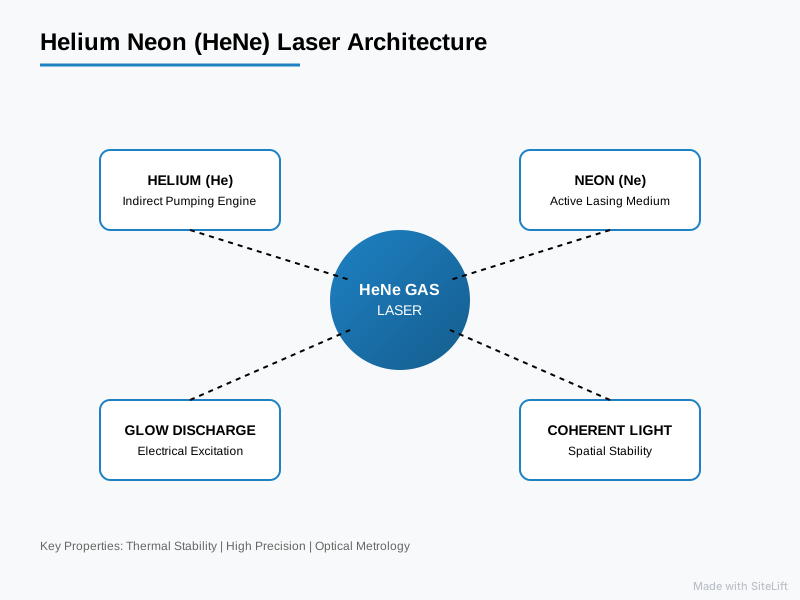
Unlike semiconductor lasers that generate photons across a diode junction, a gas laser relies on individual atoms suspended within a low-pressure envelope. Helium acts as an indirect pumping engine, while neon serves as the active lasing medium.
When an electrical current runs through the gas, electrons collide with the energetic helium atoms. These collisions do not emit laser light directly; instead, they store energy in long-lived, excited atomic states. Because neon by itself is difficult to excite efficiently with direct electron impact, helium does the heavy lifting, preparing the system for a cascade of coherent photons.
The Helium Neon Gas Mixture: Ratios and Partial Pressures
The performance of the discharge tube depends heavily on gas stoichiometry and vacuum engineering. According to the technical optics compendium RP Photonics, the standard helium-to-neon gas mixture ratio typically ranges from 5:1 to 10:1 helium to neon at total gas pressures of approximately 100 to 300 Pascals (1 to 3 mbar).
Maintaining this specific pressure window is vital:
- If the partial pressure of helium is too low, the excitation transfer efficiency drops dramatically.
- If the total pressure rises too high, non-radiative collisions quench the excitation before stimulated emission can occur.
       [ Electrical Discharge ]
                  │
                  ▼
         Excited Helium Atoms (2¹S, 2³S)
                  │
      Resonant Collisional Transfer
                  │
                  ▼
          Excited Neon Levels (3s, 2s)
                  │
        Stimulated Emission (Photon)
                  │
                  ▼
           Ground State Neon
Collisional Energy Transfer and Population Inversion Mechanisms
The true genius of the HeNe lies in resonant collisional excitation transfer. Helium atoms have two metastable excited states ($2^1S_0$ and $2^3S_1$) with exceptionally long lifetimes because dipole transitions back to their ground state are quantum-mechanically forbidden.
Conveniently, these metastable helium energy levels align closely with the $3s$ and $2s$ electron energy levels of neutral neon. When an excited helium atom bumps into a ground-state neon atom, energy transfers across with near-perfect resonant efficiency.
This collision continuously pumps neon atoms into higher energy states, generating a steady population inversion relative to the lower $2p$ energy levels. When an initial photon triggers stimulated emission, the inversion collapses down to the $2p$ sub-levels, releasing a coherent photon in the process before rapidly decaying back to the ground state.
What Are the Key Neon Emission Lines and Optical Characteristics?
While red is the classic hue associated with the HeNe, neon atoms feature a surprisingly diverse spectrum of energy levels.
The Classic 632.8 nm Red Wavelength
The transition from the neon $3s_2$ level to the $2p_4$ level produces the signature red emission line. According to reference data from the National Institute of Standards and Technology (NIST), the primary red helium-neon laser emission in air has a standard reference wavelength of 632.816 nm, with vacuum wavelength stabilization achievable to within parts per billion.
Because this specific transition has a relatively low optical gain, the resonator mirrors must exhibit extremely high reflectivity—often exceeding 99.8% on the rear reflector—to sustain continuous-wave (CW) oscillation.
Alternative Neon Emission Lines: Green, Yellow, and Infrared
By engineering dielectric mirror coatings that maximize reflectivity at alternative wavelengths while suppressing the dominant 632.8 nm line, specialized tubes can emit across different bands:
- 543.5 nm (Green): Widely used in confocal microscopy and cell biology imaging.
- 594.1 nm (Yellow): Popular for specialized flow cytometry and biomedical fluorescence.
- 611.9 nm (Orange): Utilized in testing optical filters and photolithographic masks.
- 1.15 μm and 3.39 μm (Infrared): The 1.15 μm line was actually the very first HeNe wavelength demonstrated in 1960 by Ali Javan, William Bennett Jr., and Donald Herriott; the 3.39 μm transition exhibits enormous gain and requires careful suppression in visible tubes.
Spatial Coherence, Longitudinal Modes, and TEM00 Beam Quality
Where the HeNe truly pulls away from modern diodes is beam perfection. Gas lasers naturally operate in a pure transverse electromagnetic mode ($text{TEM}_{00}$). This produces an almost mathematically ideal Gaussian profile with an $M^2$ beam quality factor comfortably below 1.05.
Furthermore, because the low-pressure gas medium possesses an exceptionally narrow Doppler-broadened gain bandwidth (around 1.5 GHz), the coherence length of a basic commercial tube can easily exceed 20 to 30 centimetres. In specialized systems using single-frequency active cavity stabilization, coherence lengths scale to several metres, making them indispensable for high-resolution holographic recording and long-range phase interferometry.
Inside the HeNe Plasma Tube: Engineering and Anatomy
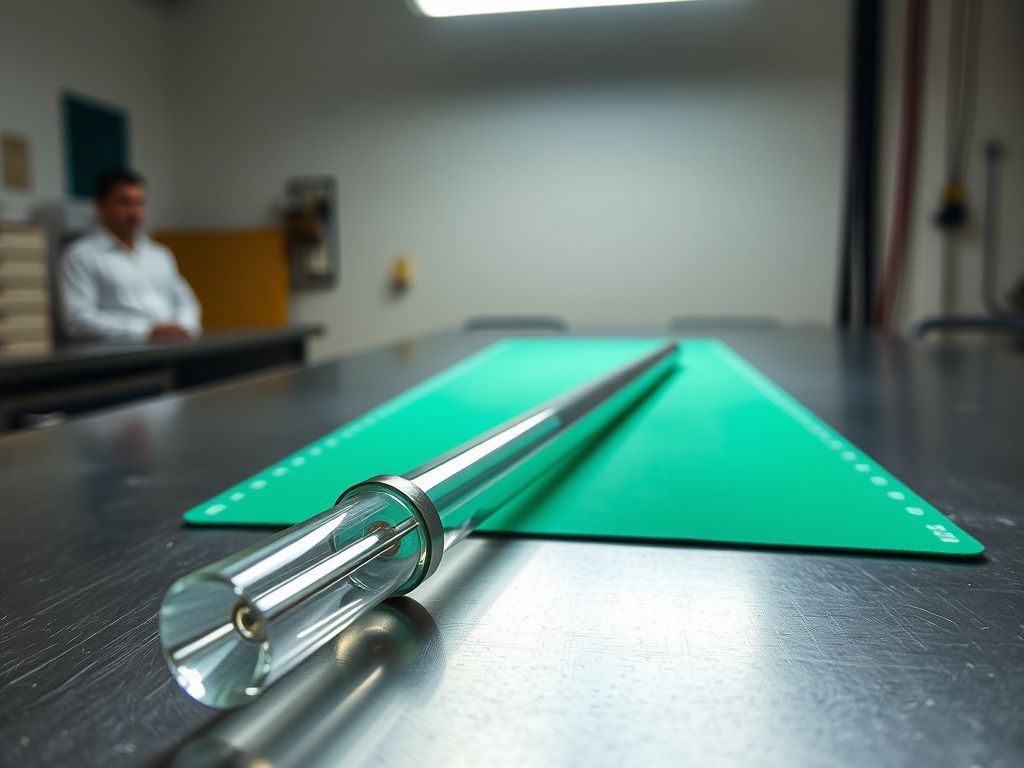
A gas laser discharge tube is an exacting piece of vacuum hardware designed to sustain a clean plasma discharge over decades of use.
Anatomy of the Capillary Bore and Cold Cathode
The heart of the system is a precision-drawn borosilicate or fused-silica capillary bore. This central narrow channel constricts the glow discharge, keeping current densities high to maximize excitation efficiency.
Surrounding the bore is an oversized glass ballast reservoir, home to a cylindrical cold cathode made of treated, low-work-function aluminium. The large surface area minimizes sputtering—a degrading process where accelerated ions kick metal atoms off the surface, which can trap neon gas atoms and deplete the envelope pressure over time.
Brewster Windows vs. Internal Hard-Sealed Mirrors
Manufacturers mount the optical cavity mirrors using one of two primary methods:
- Internal Hard-Sealed Mirrors: The laser cavity mirrors are directly fused onto the glass or Kovar metal end-caps using glass-to-metal frit seals. Data from leading industrial tube manufacturers such as Research Electro-Optics (REO) indicates that hard-sealed internal mirror HeNe plasma tubes routinely achieve operating lifespans exceeding 25,000 to 40,000 continuous hours.
- External Cavity Brewster Windows: For polarization-sensitive applications or tunable multi-line setups, the tube ends are sealed with optical-grade windows tilted precisely at Brewster’s angle ($approx 56^circ$ for silica). This eliminates reflection losses for p-polarized light, delivering a linearly polarized output beam while allowing users to swap external mirrors.
Pro Tip: When choosing between internal mirror tubes and external Brewster assemblies for custom setups, remember that external cavities demand climate-controlled, dust-free housings. Any microscopic particulate deposition on a Brewster window will dramatically degrade intra-cavity gain.
High-Voltage Ignition and Ballast Resistance Requirements
Powering a gas tube is vastly different from driving a low-voltage semiconductor. The cold helium-neon mix acts as an electrical insulator until broken down.
Operation requires a two-stage approach:
- Ignition (Strike): An open-circuit high-voltage pulse of 5 to 10 kV direct current (DC) ionizes the gas column.
- Sustain (Run): Once the arc forms, dynamic resistance turns negative. The power supply drops into a constant-current mode delivering 1 to 2 kV DC at 3 to 7 mA.
To prevent the plasma from running away and destroying the tube, an external ballast resistor (typically 60 to 100 kΩ) must be installed in series as close to the anode pin as physically possible to suppress parasitic cable capacitance.
What Safety Protocols Are Essential for Operating Helium-Neon Lasers?
Safely integrating these lasers means managing both beam radiation and high-voltage electrical hardware.
+---------------------------------------------------------------------------------+
|                                 SAFETY OVERVIEW                                 |
+------------------------------------+--------------------------------------------+
| Optical Hazards                    | Electrical Hazards                         |
| • Class 2 to 3B under EN 60825-1  | • 5-10 kV DC strike ignition potential     |
| • Blink reflex protection (<1 mW)  | • 1-2 kV continuous supply at 3-7 mA       |
| • Mandatory eyewear for Class 3R/B | • Lethal residual filter-capacitor charge  |
+------------------------------------+--------------------------------------------+
Laser Radiation Safety: Managing Class 2, 3R, and 3B Risks
Most red alignment tubes emit between 0.5 mW and 5 mW, falling under Class 2, Class 3R, or occasionally Class 3B according to the European standard EN 60825-1:
- Class 2 ($le 1text{ mW}$): The human blink reflex (averaging 0.25 seconds) provides natural physiological protection. Deliberately staring into the direct beam must still be avoided.
- Class 3R ($1text{ to }5text{ mW}$): Poses a low risk to unassisted eyes, but direct intra-beam viewing remains hazardous over long distances. Alignment eyewear with OD 2+ protection at 633 nm is recommended in OEM development setups.
- Class 3B ($>5text{ mW}$ up to 35 mW output): Direct exposure and specular reflections cause immediate retinal injury. Interlocked enclosures, emission indicators, and dedicated safety officers are mandatory in Dutch research and industrial settings.
High-Voltage Electrical Hazards in OEM and Lab Environments
Ironically, the main hazard of a commercial HeNe system is usually the power supply, not the light. While a 1 mW laser beam will rarely cause severe skin trauma, the 8 kV DC strike voltage from a switched-mode laboratory supply can easily trigger involuntary muscle spasms or cardiac arrhythmias.
Always discharge the anode lead through an insulated grounding probe before servicing, and verify that the inline ballast resistor does not have exposed solder joints.
Tube Handling, Thermal Dissipation, and Disposal Regulations in the EU
A fragile plasma tube under vacuum is prone to implosion if subjected to mechanical stress, thermal shock, or improper mounting clamps.
- Mounting: Clamps should seat securely around designated rubber-cushioned zones, never directly over mirror mounts or the glass-to-metal seals.
- Thermal management: Uniform heat dissipation across the outer envelope prevents thermal lensing that can tilt internal mirrors out of alignment.
- EU Compliance: End-of-life disposal must strictly follow European WEEE and RoHS frameworks. While neon and helium are completely non-toxic noble gases, the glass envelope, Kovar leads, and aluminium electrodes must be processed through registered electronic scrap routes rather than general lab waste.
Infographic by SiteLift
Where Are Helium-Neon Lasers Deployed in Modern Photonics?
Despite the popularity of tiny diode alternatives, gas lasers anchor some of the most critical high-precision industries on earth.
+-------------------------------------------------------------------------------+
|                      HELIUM-NEON APPLICATIONS AT A GLANCE                     |
+------------------------------------+------------------------------------------+
| High-Tech Metrology                | Optical Alignment & Standards            |
| • ASML wafer scanner stages        | • MTF testing for industrial lenses      |
| • Laser Doppler Vibrometry (LDV)   | • Primary wavelength calibration source  |
| • Sub-nanometre CMM encoders       | • Confocal fluorescence microscopy       |
+------------------------------------+------------------------------------------+
Interferometry, Laser Doppler Vibrometry, and Metrology
In the southern Netherlands—anchored by ASML, VDL ETG, and precision machine builders—sub-nanometre positioning of motion stages relies on multi-axis heterodyne interferometry.
Because of the exceptionally pure spatial mode and long-term coherence length, stabilized HeNe lasers serve as absolute length standards. When split and recombined, their wavefronts produce high-contrast interference fringes that measure displacements down to fractions of a nanometre.
Similarly, Laser Doppler Vibrometry (LDV) relies on the stable optical carrier frequency of a 632.8 nm beam to measure vibrations in structural aerospace elements and micro-electro-mechanical systems (MEMS) non-destructively.
Optical System Alignment and Spectrometer Calibration
Because neon transitions are immutable atomic constants governed by quantum mechanics, a HeNe laser will never drift due to thermal aging or drive current variations. This makes them the definitive tool for:
- Calibrating absolute optical dispersion in high-resolution spectrometers.
- Evaluating the Modulation Transfer Function (MTF) of complex lens assemblies.
- Aligning deep-ultraviolet (DUV) and extreme-ultraviolet (EUV) optical paths using visible trace beams.
HeNe Gas Lasers vs. Diode Alternatives: Why HeNe Still Holds Ground
Engineers often ask: “Why not just use a 635 nm visible laser diode (VLD) or a frequency-doubled DPSS laser?” The table below highlights why the trade-off is not so simple:
| Parameter | Helium-Neon (HeNe) Laser | Visible Diode Laser (VLD) | Single-Frequency DPSS |
|---|---|---|---|
| Wavelength Stability | Extremely high ($approx$ ppb with stabilization) | Poor; drifts with temperature ($approx 0.2text{ nm/}^circtext{C}$) | High, but vulnerable to mode hops |
| Beam Profile ($M^2$) | Pure $text{TEM}_{00}$ ($M^2 < 1.05$) | Elliptical, astigmatic ($M^2 > 1.3$) | Good ($M^2 approx 1.1 – 1.2$) |
| Coherence Length | 20 cm to $>5text{ m}$ (stabilized) | Millimetres to few centimetres | Metres (in single-mode variants) |
| Pointing Stability | Excellent ($<0.03text{ mrad}$) | Susceptible to thermal mount shifts | Moderate |
| Electrical Footprint | Bulky high-voltage driver needed | Compact, low-voltage direct drive | Compact to moderate |
| Expected Lifespan | 25,000 to 40,000+ hours | 10,000 to 20,000 hours | 10,000 to 25,000 hours |
While a semiconductor diode is cheaper and fits onto a pocket-sized PCB, its astigmatic beam requires corrective anamorphic prisms or spatial filtering. For absolute wavefront purity and phase measurement, the gas tube remains unmatched.
Key Takeaways
- Mechanism: The helium neon system operates via resonant collisional energy transfer, where metastable helium atoms pump neon atoms to establish a clean population inversion.
- Core Wavelength: The 632.816 nm red line remains the primary metrological wavelength standard, alongside green (543.5 nm), yellow (594.1 nm), and infrared lines.
- Optical Quality: Near-perfect $text{TEM}_{00}$ spatial profile ($M^2 < 1.05$) and long coherence length provide phase purity that diode alternatives struggle to match.
- Electrical Safety: Systems require 5 to 10 kV DC strike potentials and 1 to 2 kV continuous operation, demanding proper ballast resistance and insulated servicing.
- Industrial Footprint: Essential across Dutch semiconductor equipment manufacturing, metrology calibration, and laser interferometry setups.
Why the Helium-Neon Laser is the Ultimate Precision Workhorse
In an era dominated by micro-optics and integrated photonics, gas lasers are sometimes dismissed as legacy technology. I strongly disagree with that assessment.
At Te Lintelo Systems (TLS), we regularly see high-tech design teams attempt to swap out gas systems for laser diodes to shave manufacturing costs on interferometry platforms. Almost invariably, they encounter beam astigmatism, pointing drift, mode-hopping phase noise, and temperature-dependent frequency jitter. Fixing those issues with external temperature stabilization, spatial filtering, and prism correction assemblies frequently costs more time and money than simply mounting a robust, hard-sealed gas tube in the first place.
When your application requires clean wavefront coherence, uncompromising wavelength predictability, and decades of steady operation, the helium-neon architecture remains our top recommendation.
The true mark of optical precision is not how small your laser package is, but how reliably it holds its phase when measuring at the sub-nanometre scale.
— tlsbv.nl
Exploring HeNe Solutions for Research and High-Tech OEM
If you are developing custom laser metrology or upgrading high-precision inspection tools, choosing the right tube configuration and power supply makes all the difference.
Whether your application calls for standard ruggedized tubes from our Helium-Neon Laser Series or specialized polarized He-Ne lasers and modules, selecting the right optics ensures your project delivers absolute precision from day one.
Frequently Asked Questions About Helium-Neon Lasers
What is the optimal helium to neon gas ratio in a HeNe laser?
The optimal ratio generally falls between 5:1 and 10:1 helium to neon, operating at a total pressure of 1 to 3 mbar (100 to 300 Pa). This specific partial pressure balance maximizes the probability of resonant collisional energy transfer from the metastable helium $2^1S_0$ state to the neon $3s_2$ level while preventing self-quenching collisions.
Why is the 632.8 nm red line the most common HeNe wavelength?
The 632.8 nm transition balances high quantum efficiency, accessible optics fabrication, and low cavity threshold requirements. While other transitions produce green (543.5 nm) or yellow (594.1 nm) light, those transitions have significantly lower optical gain and require specialized dielectric mirror coatings with negligible scatter and absorption losses.
What is the typical operating lifespan of a HeNe plasma tube?
A modern hard-sealed commercial HeNe plasma tube routinely operates between 25,000 and 40,000 continuous hours. The lifespan is primarily limited by cathode sputtering and very slow gas depletion through the glass envelope, rather than thermal degradation of the active lasing medium.
Why do metrology labs choose HeNe lasers over solid-state diode lasers?
Metrology environments prioritize beam wavefront perfection and spatial coherence. Gas lasers naturally output an unclipped Gaussian $text{TEM}_{00}$ mode with $M^2 < 1.05$ and maintain narrow, unshifting emission lines anchored to atomic energy transitions. Diode lasers exhibit beam astigmatism, higher divergence, and temperature-induced wavelength drift that degrade nanometre-scale interferometric measurements.
What safety precautions are required when servicing a HeNe laser power supply?
Service personnel must turn off the main AC power, disconnect the supply, and discharge any internal filter capacitors using an insulated high-voltage probe before touching the leads. Because these power supplies produce an ignition strike voltage between 5 and 10 kV DC, direct contact with unshielded anode wiring can deliver dangerous electrical shocks.